

CHAPTER 12: THE FUTURE IS NOW
The world is getting more connected and more demanding. Today, we expect our networks to be instant, reliable, and invisible, carrying every message and image without a flicker of hesitation. What used to be luxuries—high-definition video calls, live event streaming, smart home devices—are now everyday expectations. Mesh networking is evolving to meet this new reality, and it’s reshaping what we can accomplish by linking devices together.
In many ways, mesh has become the backbone of modern life. Its strength comes from the way it adjusts automatically to changing conditions. Whether you’re a family in a suburban neighborhood, a small business in a brick warehouse, or a rescue team on a storm-lashed coastline, the principle is the same: when traditional connections falter, mesh steps in to bridge the gap.
Innovations in Motion: 5G and High-Density Events
It's fascinating to see how these innovations are already changing what’s possible. One evening last spring, Priya, a consultant based in Frankfurt, found herself speeding across Germany on a train that became her mobile office. The railway had begun testing a mesh-enabled 5G system designed to let passengers’ devices connect through each other. When Priya’s laptop lost contact with one node, it found another, allowing her to finish a presentation for a Toronto client without a single interruption.
This combination—5G’s speed with mesh’s resilience—is solving the problem of rural areas or crowded events where towers are too far apart. At a summer music festival in Denmark, more than forty thousand people stayed connected because organizers set up a mesh Wi-Fi built for high-density events. Each node shared the load across different channels, moving signals to clearer paths as others grew crowded.
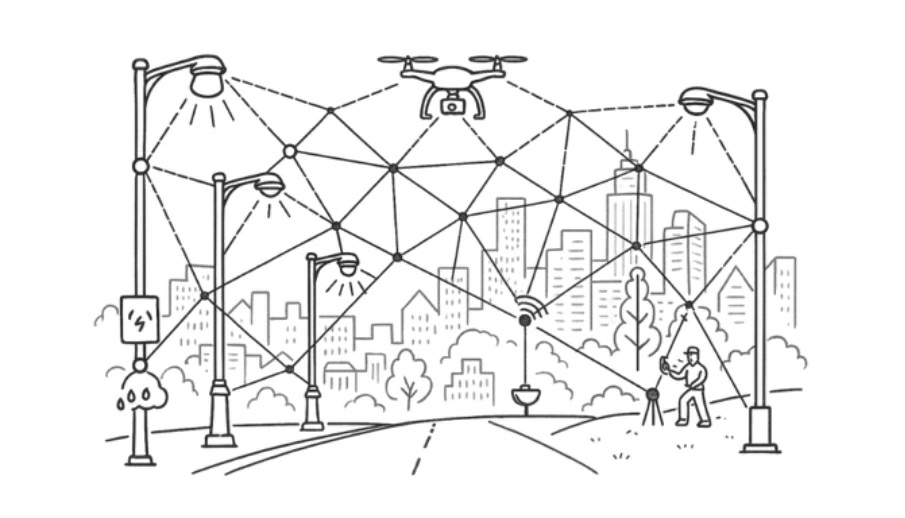
Scaling Your Mesh: Neighborhood to Region
The rules for choosing nodes in a mesh network shift as distance and latency increase. We can unpack this in three specific layers:
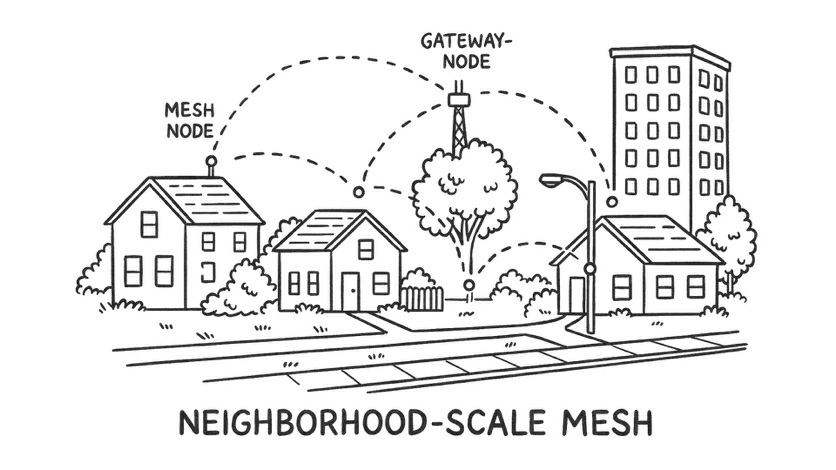
1. Neighborhood-scale mesh (Hundreds of feet to a few blocks)
The main goal is coverage and reliability. Lines-of-sight aren't mandatory if you use Wi-Fi mesh or sub-GHz radio bands (900 MHz). Nodes should be placed every 2–3 houses (100–200 meters) on rooftops or streetlight poles. A key strategy is to keep no more than 3–4 hops between any node and a gateway to manage latency.
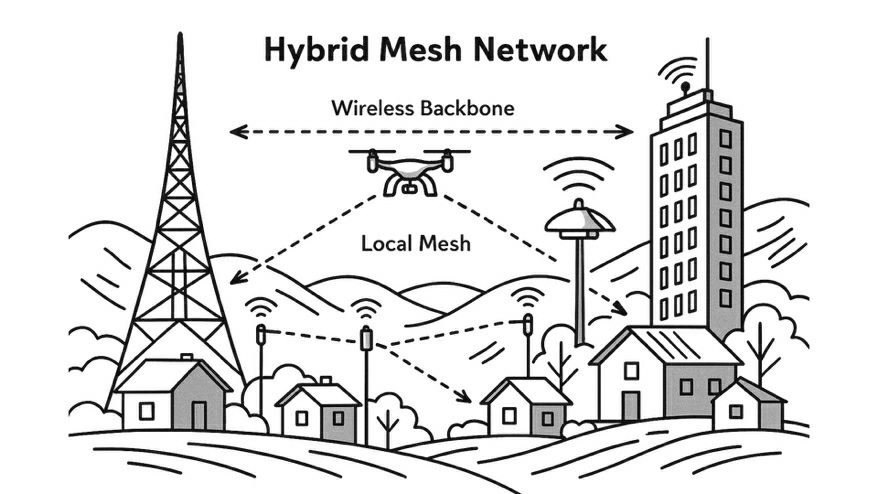
2. Community or multi-mile mesh (1–20 miles)
Distance and terrain require a hybrid backbone. Nodes should be mounted on silos, ridgelines, or tall buildings using directional antennas (5 GHz or 60 GHz). Backbones are typically spaced 1–5 miles apart where line-of-sight is available. Drones can be used to fill coverage gaps during large community events.
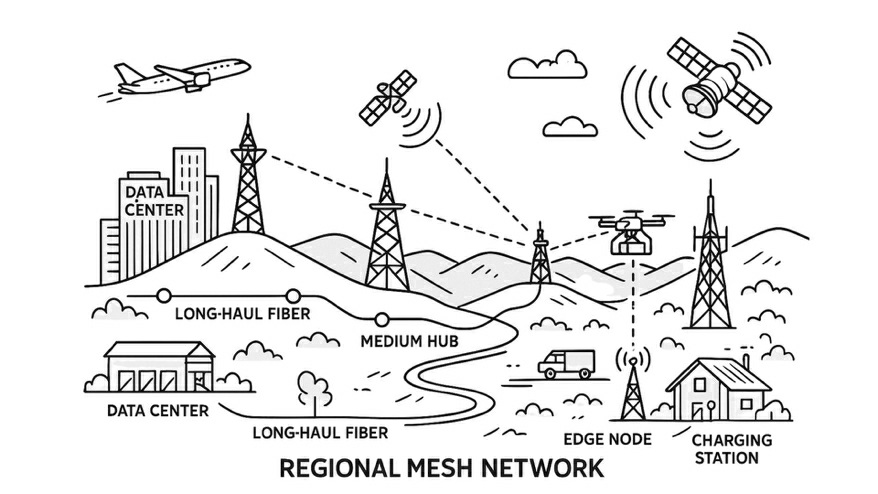
3. Wide-area or regional mesh (Hundreds of miles)
At this scale, the mesh becomes a logical integration of fiber, microwave, and satellite. It requires "supernodes" like data centers or municipal towers anchored by microwave relays spaced 20–50 miles apart. Some communities use "drone stations" on rooftops that activate automatically when AI detects a coverage gap.
Summary: Node Selection by Scale
| Scale | Distance | Antenna Type | Key Challenge |
|---|---|---|---|
| Neighborhood | 100–200 m | Omnidirectional | Interference & density |
| Multi-mile | 1–5 mi | Directional (LOS) | Terrain & weather |
| Regional | 20–50 mi (hubs) | Microwave / Fiber | Latency & coordination |
The Invisible Foundation
The future belongs to networks that learn and adapt. Home Wi-Fi will grow more responsive, and video calls will feel face-to-face. Mesh is no longer just a technology for when everything fails; it is the dependable foundation for sharing and collaborating. Alex, the business consultant, saw this firsthand during a power outage when neighbors wandered out to meet each other. That outage turned into a project to help the next neighborhood down the road establish their own mesh. Connectivity is built into the networks you rely on every day, helping you say: I’m here. I’m safe. I’m connected.