
CHAPTER 13: WHAT IS RIGHT FOR YOU?
Choosing how you’ll stay connected depends upon about deciding what matters most to you: reliability, simplicity, independence, or cost. This chapter will walk you through the strengths and trade-offs of mesh networks and traditional setups, so you can make an informed choice that feels right for your home, your business, or your community.
Traditional Networks And Where They Shine
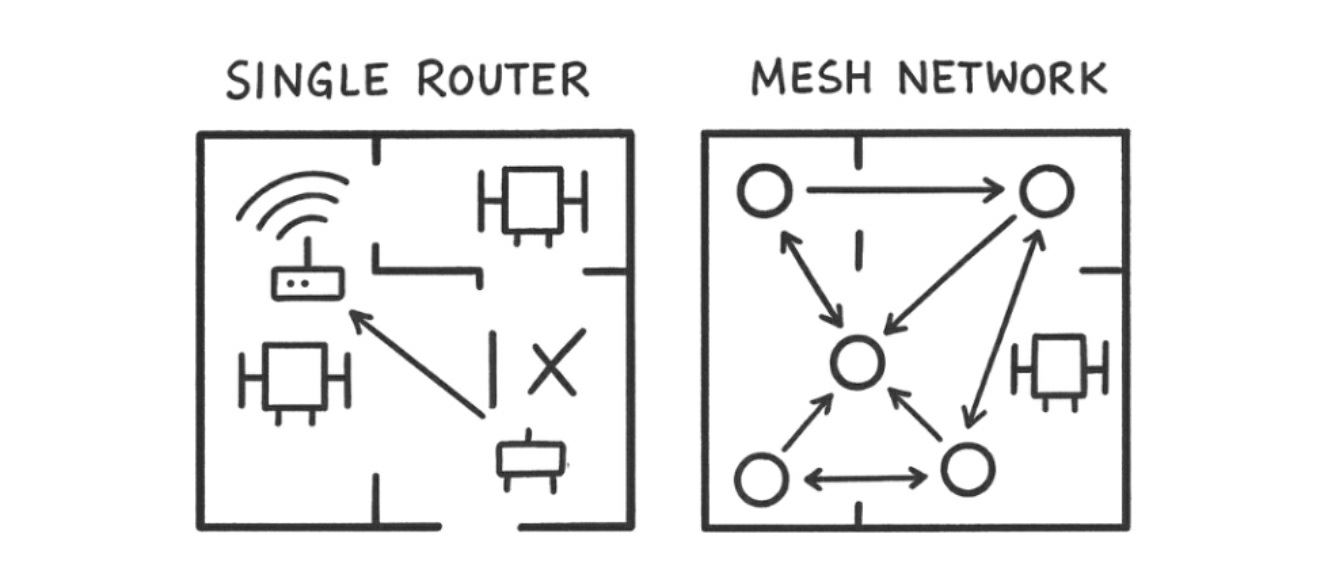
Most of us have lived with the same basic network model for years. A single modem or router sits in a central spot. All your devices connect to that hub, and if the router goes offline, everything stops. For a small home or a modest office, a traditional setup can be enough, especially if your needs are predictable and the coverage area is limited. But as more devices come online, you might notice dropped connections, lag during video calls, or dead zones.
The Neighborhood Bakery
Consider Morning Rise Bakery, run by Carlos and Elena. They relied on one inexpensive router until a holiday rush hit. Extra staff and customers connected at once, and the single router couldn’t keep up. Orders froze and gift card sales stalled, costing them hundreds in revenue. That’s when they realized the simplest setup has hidden limits.
Mesh Networks: Flexibility And Resilience
In a mesh network, all your devices pitch in. In everyday life, this means moving from your office to your patio without dropping a call. Sarah, who runs a design studio out of a converted garage, initially hesitated at the cost but found that a mesh system provided seamless coverage her clients noticed. When a storm knocked out power to part of the building, the remaining nodes kept her team online. Sarah later said, “It felt like we suddenly we had entered the modern age and taken control of our destiny.”
The Cost Question: What You Can Expect To Spend
Mesh systems involve higher initial costs because each node is an investment. For homes, brands like Eero, Google Nest Wifi, and TP-Link Deco sell starter kits (2-3 nodes) for about $200 to $500, covering up to 6,000 square feet. Additional nodes are roughly $100 to $200 each.
Businesses often look at Ubiquiti UniFi or EnGenius. Entry-level nodes in these systems typically cost between $150 and $400 each. Advanced outdoor or enterprise-grade nodes can range from $500 to $1,500. Sarah’s studio upgraded to a three-node Eero Pro 6E kit for about $600 and later added another node for $200. While she spent more upfront, the stability and coverage paid for itself.
Quick Comparison: Traditional vs. Mesh
| Feature | Traditional Network | Mesh Network |
|---|---|---|
| Setup Complexity | Simple (One device) | Moderate (Multiple nodes) |
| Coverage | Limited to router range | Scales easily across large spaces |
| Reliability | Single point of failure | Self-healing; traffic reroutes |
| Cost (Upfront) | Lower | Higher |
| Best For | Small spaces, basic needs | Large homes, businesses, backups |
Control, Independence, And When To Keep It Simple
Traditional networks rely heavily on your internet service provider (ISP). If your ISP has an outage, you’re stuck. Mesh networks, especially community-built systems, offer more independence. In a neighborhood mesh, you and your neighbors decide how the network runs and grows. If you have a small space with rare outages and don't expect your needs to grow, it can make sense to keep things simple and save money.
Reflect Before You Decide
Choosing a network is about knowing what you need most: confidence in a crisis (Mesh), a fast setup (Traditional), room to grow (Mesh), or a tight budget (Traditional). Take a moment to note your top three priorities—whether it’s schoolwork, video calls, or business stability—so the right choice becomes obvious.
Once several neighborhoods had established mesh networks, Alex decided to invite everyone to link the networks together. Within months, he established monthly “porch hours” for training. The neighborhoods liked being connected safely and securely, and reliable internet even became a selling feature when homes went on the market. Alex could never have anticipated the positive benefits of self-reliance for communication. Explore platforms like LibreMesh or entry-level Wi-Fi kits to see how it works in your space.