
CHAPTER 2: HOW WE LEARNED TO TALK ACROSS MILES
As a social species, talking with each other has always been the backbone of safety and connection, especially when the unexpected happens. Whether you’re a business leader making urgent decisions, a parent checking on your family, or someone trying to stay informed, knowing how we moved from smoke signals to smartphones reveals why today’s tools matter more than ever. Understanding this evolution is an interesting journey and the key to feeling confident about which options to trust when the stakes are high. With a clear perspective on how each breakthrough shaped the next, it becomes easier to build a dependable plan without getting lost in jargon or overwhelmed by complexity.
The First Signals
Imagine you’re standing on a hill with an urgent message to deliver. No phone in your pocket, no internet connection, not even a mailbox. What do you do? Thousands of years ago, people faced this problem every day, and they came up with ingenious ways to solve it. In China and among Native American nations, smoke signals served as a fast-warning system. A single column of smoke could mean all was well. A series of puffs might signal danger. If you knew the code, you could read these messages from miles away. I imagine that they made some allowances in the strength of the smoke on windy days to avoid inciting a panic in the next village. In parts of Africa, the talking drum was just as vital. Its beats echoed across villages, carrying stories, announcements, and instructions. The drums mimicked speech so accurately that a skilled listener could almost hear a sentence in each rhythm.
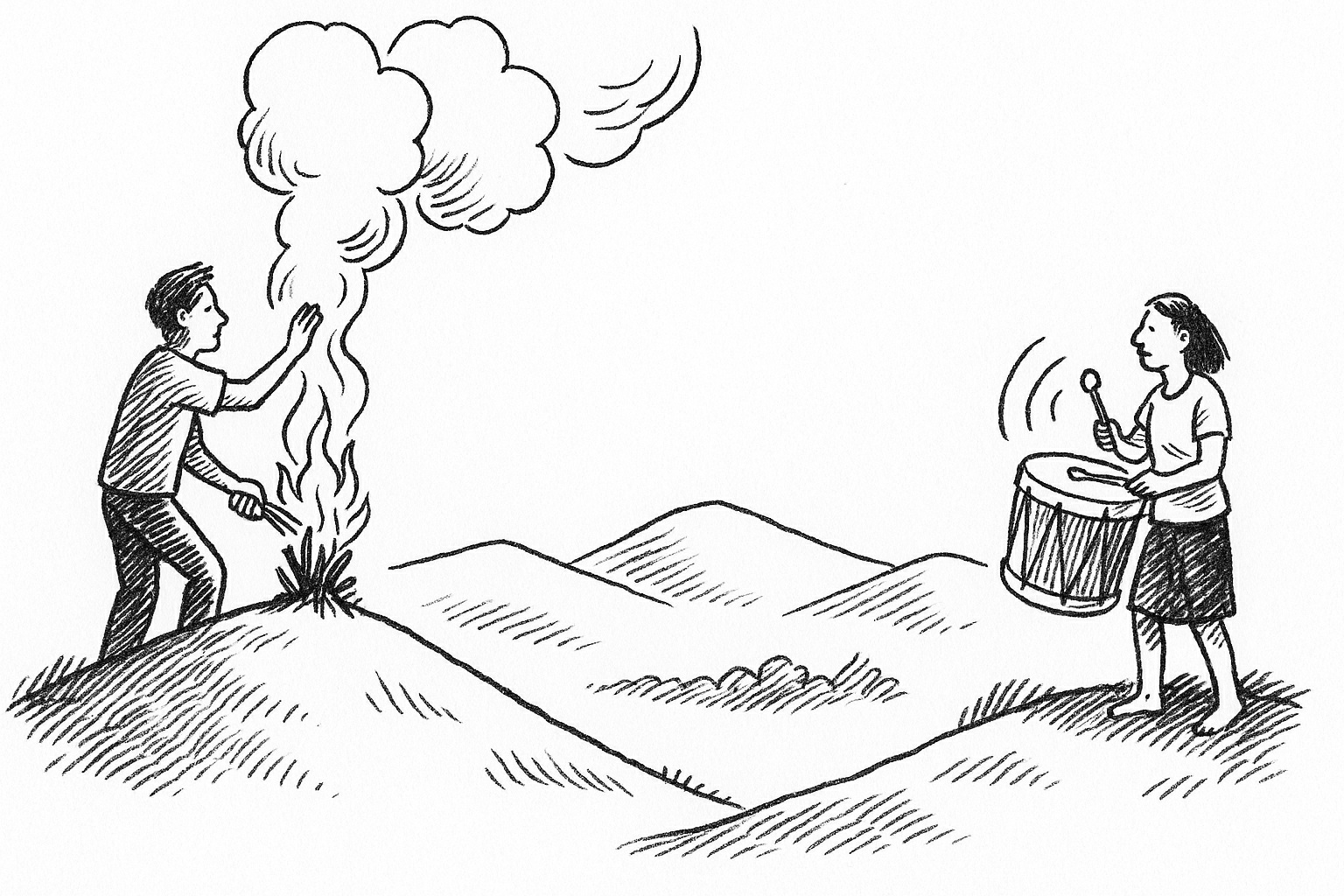
These early systems taught us something we still rely on today: every community needs a way to share information quickly when lives depend on it.
Writing That Could Cross Generations
Then came writing. Suddenly, humans could store ideas instead of relying only on memory and voice. Clay tablets, papyrus scrolls, and eventually paper turned words into something that could be shared with other people when you weren’t with them. Writing made it possible to share ideas far beyond the horizon and even forward in time. That same drive to document and distribute information fuels today’s tools—whether it’s instant cloud backups or a message sent out over a private mesh network.
From Dots And Dashes To Familiar Voices
Centuries later, technology took a massive leap. In the 1830s, Samuel Morse developed the telegraph, using electric currents to send coded messages over wires. For the first time, information traveled faster than any horse! It was such a marvel that people called it “lightning communication.” This set the expectation we still carry today that news should move as fast as the world around us.
But we weren’t satisfied with dots and dashes alone. We wanted to hear each other’s voices. In 1876, Alexander Graham Bell made that dream real with the telephone. Imagine how astonishing it was to lift a receiver and speak to someone hundreds of miles away as if they were in the next room. The telephone brought distant families closer and made business more efficient than ever. Every time you pick up a phone or join a video call, you’re leaning on the idea that real-time connection should feel natural and immediate.
Wireless Waves That Changed Everything
By the turn of the 20th century, wires began to loosen their hold. Guglielmo Marconi’s work on radio meant that signals could soar through the air. Radio connected ships at sea and brought news, music, and entertainment into every living room.
When television arrived in living rooms across the mid-20th century, it also reshaped how we connect to one another. For the first time, entire nations could see and hear the same stories at the same moment, whether it was the moon landing, a presidential address, or the nightly news anchor summarizing the day’s events in an even tone.
Even disagreement unfolded against a common backdrop of information; people might argue about politics, but they were arguing about the same set of facts delivered by the same trusted sources. In rural towns or dense cities alike, television served as a kind of hearth, its glow drawing people into a shared narrative of modern life. In the United States, programs such as CBS Evening News or The Today Show created a rhythm to public life, while in Britain, Panorama and News at Ten unified citizens around common reference points.
The global reach of televised events, from the 1969 Apollo landing to the fall of the Berlin Wall, transformed the idea of community from local to planetary, allowing millions to feel part of the same unfolding human story. Though television often reflected cultural divisions, its one-to-many broadcast model created a shared baseline of knowledge and emotion that digital media, with its endless personalization, has largely eroded. In its golden age, television gave societies the facts but also a sense of shared reality, a collective understanding that they were witnessing history together, in real time, from the same source.
The Internet And The Smartphone Revolution
Then came the internet, an invention that reshaped everything. What began as a modest network linking researchers grew into a global system that reaches into nearly every corner of life. Emails replaced letters. Instant messages replaced phone calls. Social media gave everyone a voice that could echo worldwide in seconds. And when smartphones appeared, they folded all those tools into a single, pocket-sized device. A person standing on a mountain could tap a screen and instantly video chat with someone in another hemisphere.
Artificial intelligence has become the next wave of change, reshaping how we communicate in ways big and small. Smart assistants like Siri and Alexa respond to our voices, translating spoken commands into actions almost instantly. AI chatbots handle customer service around the clock, answering questions and guiding people without human intervention. Even the way we write messages has evolved, with predictive text and autocorrect helping us craft clear, polished replies. Behind the scenes, AI filters spam, flags harmful content, and tailors the news and updates we see, customizing information to match our interests. In just a few years, AI has transformed the simple act of sending and receiving messages into something faster, more intuitive, and more personal than ever before.
Yet this hyper-personalization has come with a cost. The more our screens learn about us, the less we share a common reality. Instead of everyone watching the same nightly news, algorithms now curate thousands of tiny, customized versions of the world, each one shaped by past clicks, preferences, and biases. The ability to “control the narrative” has always been desirable to companies who publish newspapers, magazines, websites, and social media channels. That narrative can vary from someone telling their own story to outright propaganda depending upon the goals of the media outlet. In the U.S., media consolidation has dramatically increased over the past few decades. During the 1980s there were dozens of companies controlling most media; by the 1990s–2000s, that number had shrunk to roughly six major corporations including The Walt Disney Company, Comcast Corporation (including NBCUniversal), Warner Bros. Discovery, Paramount Global, Sony Corporation, and one or two others that account for roughly 90% of U.S. media consumption.
Each corporation leans in a certain direction regarding their coverage, with some leaning conservative and others liberal. One illustrative example: when Sinclair Broadcast Group bought a local TV station, coverage of local events dropped by around 10%, and news stories adopted a more conservative framing. Courses that teach critical thinking often encourage their students to ask “who benefits from this story” when evaluating “news” because it’s rare for a story to be reported with facts alone. In Europe, a number of large media and telecommunications corporations have exerted outsized influence over mass media. For example, the European-wide conglomerate Sky Group, now owned by Comcast, operates pay-TV and satellite broadcasting across several countries and holds a leading share of Europe's pay-TV market by revenue. The result is a media landscape in which relatively few entities can shape news, entertainment, and cultural content across many countries, potentially reducing diversity of local stories and ideas.
Media consolidation has had the unintended effect of people turning to social media for their news. Two people standing side by side can open their phones and see completely different headlines about the same event. The Pew Research Center found that in 2025, about half of U.S. adults (53%) say they at least sometimes get news from social media, a trend that is roughly stable over the previous few years. Some social media sites – despite having relatively small overall audiences – stand out as destinations for news among many of their users. For example, 57% of X users get news there, as do a similar share of users (55%) on Truth Social, the site owned by President Donald Trump’s media and technology company. Just over half of TikTok users (55%) say they regularly get news on the site, up from 22% in 2020. The shares of users who get news on some other sites, such as YouTube and Instagram, also have risen. Social media allows anyone to share their ideas and the accuracy of the “news” varies according to the post and the profile of the person or organization who posts it. While the diversity of ideas of welcome in a free society, it can be challenging when an event is “reported” with wildly different facts and commentary.
As media fragments into echo chambers, public trust erodes; truth itself begins to feel negotiable. The authority once held by a shared broadcast voice has been replaced by a chorus of influencers, niche outlets, and automated feeds that all claim authenticity but rarely overlap. What began as a way to make communication more relevant has also made it less reliable, fraying the sense of collective understanding that television once nurtured. Artificial intelligence has given us infinite perspectives but in doing so, it has made it harder to agree on what’s real. This is why we ask a friend for recommendations on what to read, learn or eat and rely less on what is pushed to us digitally. We still expect our devices to respond instantly, understand our preferences, and keep us connected wherever we go so that we can reach out to trusted friends and family.
A Real-Life Example: Connection In Crisis
In 2017, a hurricane swept across southern Florida, knocking out power and phone lines for days. Susan, a regional sales manager, had flown home early to check on her elderly parents. As floodwaters rose, traditional phone service disappeared. But thanks to her smartphone and a backup battery pack, Susan switched to a messaging app that worked over any available cellular network. Even as towers went down one by one, she was able to share her location, coordinate with rescue crews, and reassure colleagues that she was safe. For Susan and her family, wireless communication was the reason help arrived when it did. Stories like hers are reminders that modern tools are lifelines in moments that matter most.
Wired And Wireless: Two Sides Of Connection
Imagine if every message still needed a physical wire. Every call, every text, every bit of information would be tied to a physical link. Not long ago, that was everyday reality. The telegraph and telephone created the first vast webs of wired communication, running cables under streets, across fields, and eventually under oceans. Those wires made it possible to coordinate armies, run businesses, and keep families close, even across great distances.
The telegraph was the first glimpse of instant communication. By 1861, a line stretched from one side of America to the other. Messages that once traveled by horse-drawn carriage could now cross the country in moments. The telephone followed, making voices travel through copper wires, which felt miraculous at the time. As demands grew, so did the infrastructure. Copper lines gave way to fiber optic cables, which use light to carry data almost instantly and with incredible clarity. Today, massive bundles of fiber optic cables snake across ocean floors, carrying trillions of pieces of information between continents. They’re the hidden backbone of the internet, allowing us to stream movies, conduct video meetings, and store vast libraries of information. When you join a video conference or send a file overseas, you’re depending on this invisible network to keep your connection stable.
Yet no matter how fast a wire can carry a signal, there are places wires can’t easily reach—mountain villages, deserts, ships far out at sea. That’s where wireless communication transformed what was possible. It began with radio waves. Marconi’s early experiments led to ships using radios to call for help or check weather reports. Soon, families were gathering around radio sets to hear the latest news. Television built on radio’s success, adding moving pictures to sound in real time. Suddenly, people could watch the moon landing live or see major events unfold as they happened. The next big leap came with mobile phones. Early models were bulky and limited. But as cellular networks expanded, phones shrank and multiplied. By the 1990s, mobile phones were everywhere, unshackling communication from any single location. The smartphone took this a step further, merging voice, text, and internet access. With Wi-Fi and 4G—and now 5G—people could work, shop, and connect from almost anywhere. Wireless signals made the world feel smaller, helping communities without reliable infrastructure get online and opening opportunities once reserved for the few.
What The Future Holds
While wireless technologies offer freedom, wired networks still carry the heavy loads. A video call may start with a tap on a smartphone, but it relies on land and undersea cables to reach the other person. The two methods don’t compete—they cooperate. One provides stability and capacity, the other flexibility and reach. Look around your own life and make a note of which tools you depend on most and why they matter to you.
Alex, the business consultant, was relieved that the satellite app installed on his children’s phones sent location information to him even when travelling overseas. He could quickly glance at the app and confirm that they were in school or safely at home. It made being away from them on business travel a little bit easier. Looking ahead, communication will only grow more seamless. Smart cities, connected devices, and advances in wireless speed will blend both worlds until the line between wired and wireless nearly disappears. Every leap forward in connectivity has brought us closer together—and the next breakthroughs will continue that journey.