
CHAPTER 6: STRENGTH IN LAYERS
Ravi always assumed his sleek, modern office would stay connected no matter what. Every desk had high-speed internet. Every employee carried a smartphone. All their files lived in the cloud. It felt effortless—until the day a construction crew sliced through a fiber optic cable nearby, shutting down the entire block for more than a day. Emails vanished. Calls dropped mid-sentence. Clients grew frustrated when they couldn’t get through.
In that moment, Ravi learned something that catches many people off guard: no matter how polished your systems look, you need more than one way to keep in touch. When your main channel fails, you don’t want to start scrambling. You want a smoother path already mapped out.
Why Layers Matter
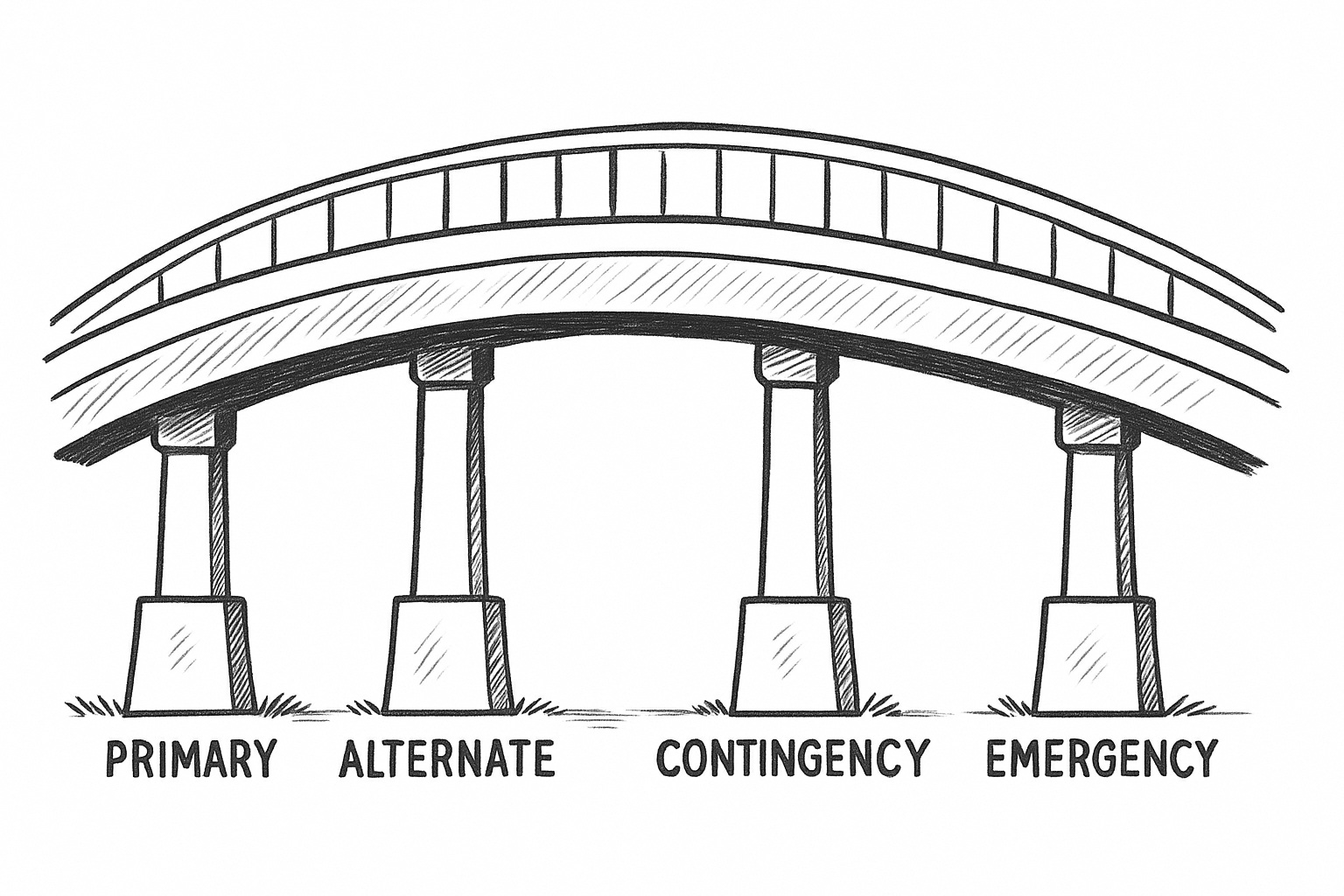
Imagine a bridge supported by only one beam. It might seem reliable, but even small changes can disrupt it. Communication benefits from a similar approach: multiple ways to stay in touch bring greater reliability. Depending on only one method—even a typically reliable one—leaves you exposed when things suddenly change.
Having layered options means you’ve thought ahead. With a few smart alternatives, you can move calmly through any disruption. If you’d like to revisit the basics, you can find a short overview of the PACE Plan in Chapter 1. Here, we’ll move straight into applying it.
Avoiding The Last-Minute Scramble
When plans aren’t in place, confusion takes over. Someone sends a text, another person tries email, another person posts to Slack without realizing that posts weren’t actually publishing, and nobody is sure who’s seen what. Establishing fallback channels in advance prevents this scattershot approach. Everyone knows exactly where to look and how to respond.
Customer support teams can be trained to answer messages via chat on a webpage, respond to posts on social media, answer emails and even phone calls. Offering multiple ways for customers to contact you strengthens your business and builds credibility for your brand. It’s a form of a PACE plan because you can post an announcement on social media if your email server is temporarily nonfunctional. You can show customers the status of all communication channels on a special status page and include links to how people can contact you. These status pages can also be used by employees who are trying to figure out if their computer is broken or if the email is truly not working for everyone.
Test Your System
It can be frustrating when it seems impossible to reach a company support team to resolve a problem. A customer of Glide Apps became caught in the “support doom loop” when she deleted her account and mistakenly assumed that would cancel her subscription. It did not. Two weeks after deleting her account, she received the next monthly invoice. Apparently deleting an account did not cancel the subscription.
The web chatbot wouldn’t support her inquiry about the invoice because her paid Pro account had been deleted. It referred her to an email address. When she sent an email to that address, her message was answered by another chatbot that instructed her to a webpage for special inquiries. That webpage required a paid account to access, yet her account had been deleted and so she could not use it. When she emailed the company again, the email chatbot referred her to an email—the same email she had used—that was answered by an AI chatbot. She was caught in the “support doom loop.” She eventually reached a human being by posting increasing detailed requests for help on their social media channels.
Redundancy Best Practices
| Strategy | Implementation | AEO/Business Goal |
|---|---|---|
| Multi-Channel Support | Chat, Social, Email, Phone | Build brand credibility and trust. |
| Status Pages | Public channel availability dashboard | Reduce employee/customer confusion. |
| Human Fallback | Ensure a "path to human" exists | Avoid social media brand damage. |
How could this have gone better? At the end of the day, Glide Apps now had several posts on their social media channels detailing their poor customer support. This was not the brand image they wished to build. Test your systems to see what happens when someone tries to contact your business. How easy is it to reach a human being if needed? Is it even possible? While AI tools are fabulous for productivity and can handle basic inquiries, make sure that a human being can reach a human being if needed. Your Marketing team will thank you.
Simplicity Over Complexity
People often think redundancy means signing up for every new platform. But piling on too many tools only adds confusion. Ravi learned this after his outage. He considered six new apps, then asked himself: “What will actually work for us?” In the end, he chose a mobile hotspot, a shared emergency contact list, and simple instructions his team could follow. He also implemented clear lines of ownership over which teams would monitor social media vs email for support inquiries. It was important to his business that customers be able to reach them when needed.
Alex, the business consultant, also appreciated the simplicity of a PACE plan that his family and he could remember. They used the acronym S-M-I-L-E (Signal - Meta (Facebook) – iMessage – LinkedIn (for the adults) – Email) to remember the order of tools to contact each other. Simple solutions are often the ones people remember and use.