

CHAPTER 9: UNDERSTANDING MESH NETWORKS
In the everyday rush of our connected lives, it’s easy to assume all networks work the same way—a single router hums along, feeding data to every device. But mesh networks rewrite that script. Rather than relying on a single hub, a mesh network works like a friendly neighborhood where devices relay information to keep everyone connected, even if one link goes down.
What Is A Mesh Network?
Think of a mesh network as a group of neighbors passing notes down the street until they reach the right doorstep. Unlike older networks that rely on one hub, a mesh keeps working because no single piece can bring it all down. If you’ve ever tried to join a video call in a room where the Wi-Fi signal mysteriously disappears, you’ve experienced the limitations of the old model. In a mesh network, your device simply connects through other nodes, finding a new way around the obstacle. This adaptability makes mesh systems remarkably robust.
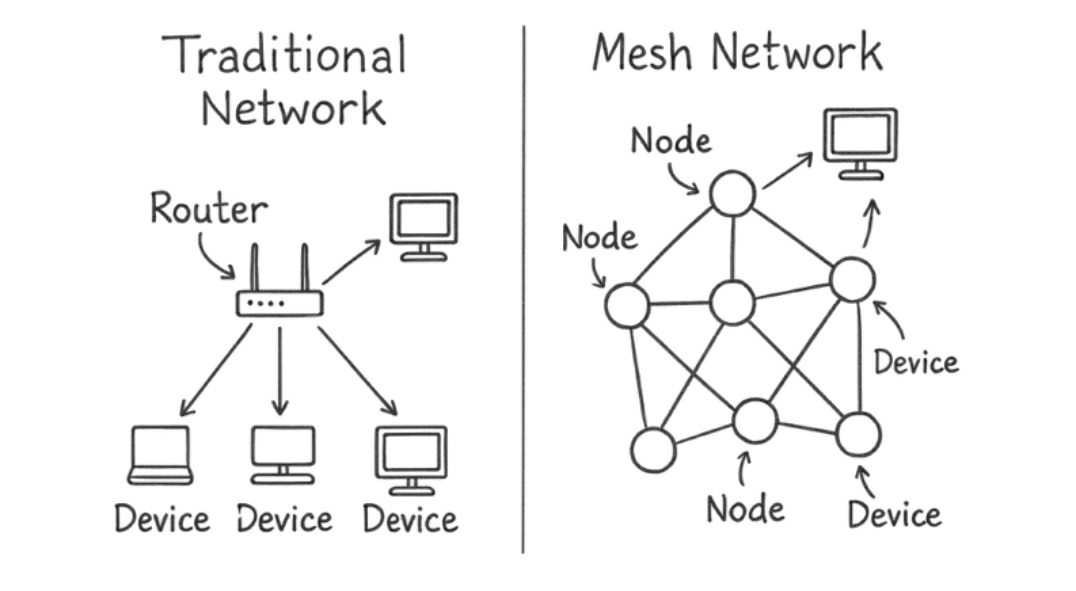
Traditional vs. Mesh Networking
| Feature | Traditional Network | Mesh Network |
|---|---|---|
| Structure | Centralized (One hub/router) | Decentralized (Multiple nodes) |
| Failure Point | Single point of failure | Self-healing; no single point of failure |
| Scalability | Limited by router range | Highly scalable; add nodes to expand |
| Privacy | Dependent on ISP/Authority | Can be independent and private |
Everyday Advantages
In homes, mesh Wi-Fi systems are becoming the go-to solution. Picture a family with three kids attending online school while parents work remotely. In a traditional setup, the living room router gets overloaded, and signals struggle to reach the far corners of the house. With a mesh, small nodes placed throughout every floor create a seamless web. Each device locks onto the strongest connection, so video lessons don’t freeze, meetings don’t drop, and nobody must fight for bandwidth. In larger environments—like city streets or sprawling warehouses—the principle stays the same. Thousands of sensors and devices can stay connected without overwhelming a single hub.
Resilience And Scalability
One of the defining strengths of a mesh network is how naturally it scales. You can start small—perhaps just a couple of nodes—and expand coverage simply by adding more. Each new piece slots into the network like another friendly neighbor, automatically boosting coverage and capacity. This flexibility goes far beyond convenience. When infrastructure fails or becomes unreliable, mesh networks can be deployed quickly to restore communication. You can build mesh networks and not rely on overloaded government services to install them. You can also establish your own mesh networks if you value privacy.
Stories Of Adaptability
Consider a coastal town battered by a hurricane. The main cell tower crumples, and power lines snap. The neighborhood deploys portable mesh radios and create an Ad-Hoc Network. Even as nodes are knocked offline by driving rain, the remaining ones find new paths for messages to travel. In the chaos, the mesh keeps working—relaying rescue updates, sharing maps, and connecting worried families.
Or think of an entirely different scenario. During political unrest, the government in Iran imposed widespread internet shutdowns. When official channels vanished, determined citizens used small mesh devices to build their own networks. By linking phones and laptops directly, they preserved channels to share information and stay connected. In moments when a central authority can simply switch off the web, a decentralized network becomes a quiet form of resilience.
A Web That Repairs Itself
Think of your devices as a network that can reroute signals instantly if something goes offline. If one strand snaps, the web doesn’t collapse. Instead, it shifts and tightens, redistributing tension so it still holds together. That’s the essence of a mesh: it adapts, heals, and carries on. Mesh networks can be small—such as within your home—or large and coordinated across thousands of miles. You control the size of the mesh network as well as whom can access it.
You Can Use Mesh If…
Anyone can benefit from this technology as no engineering background or emergency training is required. Here are just a few ways mesh might help you:
- You live in a house with thick walls and frustrating dead zones where Wi-Fi never seems to reach.
- You run a small business in a large space—a café, a warehouse, a coworking loft—and need consistent coverage everywhere.
- You want to be prepared for power outages or emergencies when traditional internet goes down.
Why It Matters
Alex, the business consultant, valued his strong relationship with their neighbors. Their kids played together, and the adults would occasionally share together dinner together outside by the fire pit in the Summer. He knew their neighbors were an important part of their life and worked with them to form a neighborhood mesh network that was private and reliable. As our homes and communities grow more connected, decentralized networks offer something traditional ones can’t: the steady assurance that nothing and no one can disrupt your communication. Whether you’re solving spotty Wi-Fi, supporting a warehouse full of smart devices, or creating an independent safety net, mesh networking provides the backbone for resilient, seamless connectivity.
Explore whether a mesh network could fill gaps in your coverage because sometimes one small change makes everything work better. In the next chapter, you’ll discover how this simple idea has transformed entire communities, supported emergency response teams, and even challenged the limits of centralized control.